Anthologies are the best way to go with Johnny Horton. In spite of his talents, his discography is inconsistent, featuring as many low points as high ones. For the most part,
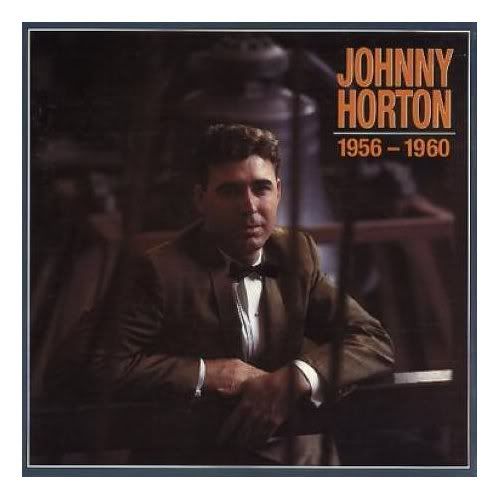
Honky Tonk Man: The Essential Johnny Horton 1956-1960 does a fine job of separating the wheat from the chaff.
Much of the reason why this singer-guitarist didn't achieve greater stardom, according to country music authority and booklet notes writer
Colin Escott, was a lack of "deep-seated commitment" to his music. A drifter from a family of drifters, Horton seemed to view being a musician as just another job that would pay the bills while he pursued more important interests like hunting, fishing, and extrasensory perception. By the early 1950s, he was a professional entertainer with a few releases on Mercury whose biggest claim to fame was marrying Hank Williams' widow. His new manager, Tillman Franks, helped him secure a contract with Columbia in 1955 and had visions of recasting him as a rockabilly. The following year, Horton had his first big hit, "Honky Tonk Man," as well as a few other singles that achieved respectable positions on the country and western charts. 1957 and 1958 were lean years, but his career peaked in 1959 and 1960 with the historically-flavored smashes "When It's Springtime in Alaska (It's Forty Below)," "The Battle of New Orleans," "Johnny Reb," "Sink the Bismark," and "North to Alaska." However, this formula eventually started to wear thin, requiring Horton and Franks to come up with another musical reinvention. They never received the opportunity to do so. Not long after allegedly having premonitions of his impending death, Horton was killed in a car accident caused by a drunk driver on November 5, 1960

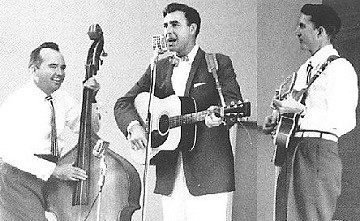
JOHNNY HORTON IN THE MIDDLE FLANKED BY TILLMAN
FRANKS ON BASS & TOMMY TOMLINSON ON ELECTRIC GUITAR
This collection's first disc predominantly features material that straddles the line between country and rockabilly, which is evident on the deservedly successful "Honky Tonk Man," "I'm a One Woman Man," "I'm Coming Home," and "The Woman I Need (Honky Tonk Mind)." However, there are also several worthwhile non-hits dating from Horton's first couple of years on Columbia, including songs with a stripped-down sound similar to early Johnny Cash and Johnny Burnette: "Take Me Like I Am," "I Don't Like I Did (Before)," "Hooray for That Little Difference," "She Knows Why," "Goodbye Lonesome (Hello, Baby Doll)," "I'll Do It Every Time," and "Let's Take the Long Way Home." Other tracks display continued musical development, such as the syncopated rhythms on "Lover's Rock," the bass strings guitar solo on the Chuck Berryish "Honky-Tonk Hardwood Floor," and the engaging arrangements on "The Wild One." The concluding four tracks come from a rare album that was recorded in early 1958 and issued exclusively to radio stations. The lame "Hot in the Sugarcane Field" is fake calypso (!), while "Wise to the Ways of a Woman" and "I Love You Baby" are so-so pop songs with hokey backing singers. "Out in New Mexico," on the other hand, is an exceptional western ballad written by Horton that would not have sounded out of place on a
Marty Robbins album.






.jpg)


